JLPT Levels Explained: N5 to N1 Guide for Students in Dehradun
If you are learning Japanese, sooner or later someone will ask, "Which N level are you?" They mean the JLPT, the Japanese-Language Proficiency Test. It is the certificate that Japanese universities, employers and immigration offices most often ask for, and it is how Japanese courses in India are organised, including ours.
This guide explains the five JLPT levels from N5 to N1 in plain terms: what each level proves, how the exam is marked, which level you need for your goal, and how a student in Dehradun can sit the test.
What is the JLPT?
The JLPT is run by the Japan Foundation and Japan Educational Exchanges and Services (JEES). It measures how well a non-native speaker understands Japanese. A few points surprise new students:
It is multiple choice. The test covers vocabulary, grammar, reading and listening. There is no speaking test and no essay.
It is held twice a year, in July and December. The next test is on Sunday, 6 December 2026.
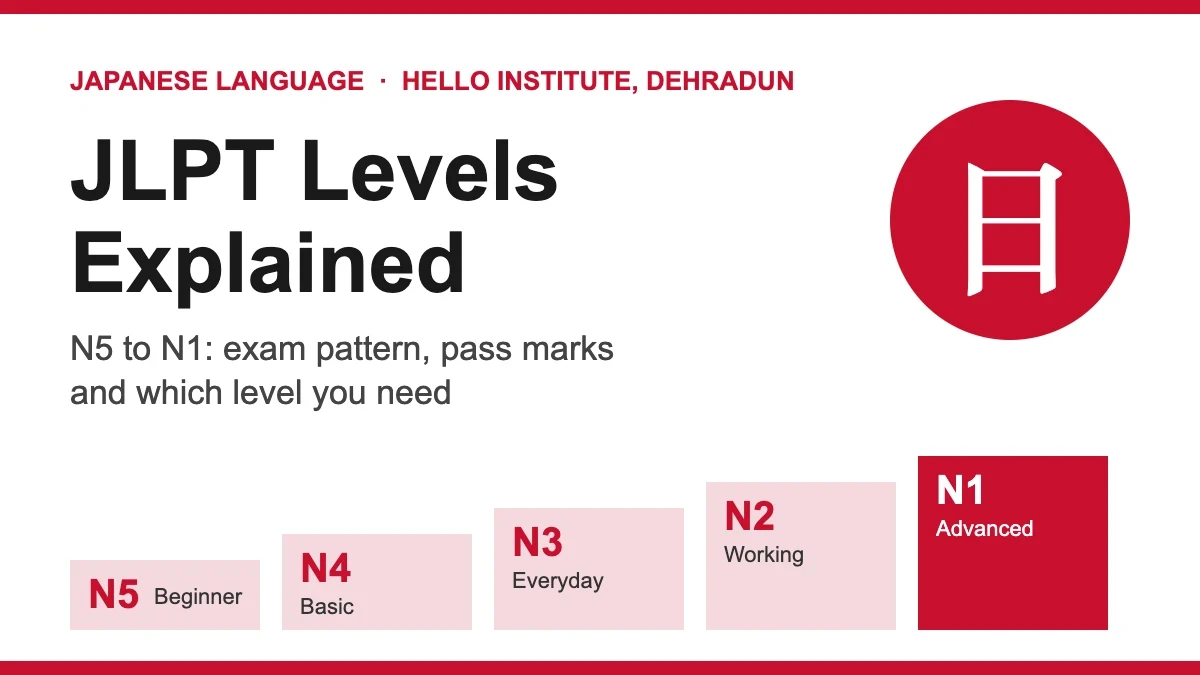
There are five levels. N5 is the easiest and N1 is the hardest.
You can enter at any level. You do not have to pass N5 before you sit N4.
You sit one level per test date, so most students move up one level at a time.
The five JLPT levels at a glance
Level
What it shows (official summary)
Total test time
Pass mark out of 180
N5
Can understand some basic Japanese
90 minutes
80
N4
Can understand basic Japanese
115 minutes
90
N3
Can understand Japanese used in everyday situations to a certain degree
140 minutes
95
N2
Can understand everyday Japanese, and Japanese used in a variety of circumstances to a certain degree
155 minutes
90
N1
Can understand Japanese used in a variety of circumstances
165 minutes
100
The total is not the only hurdle. Each section has its own minimum, and falling below it in any one section means a fail even if your total is high.
N5 and N4: at least 38 out of 120 in Language Knowledge and Reading combined, and 19 out of 60 in Listening.
N3, N2 and N1: at least 19 out of 60 in each of Language Knowledge, Reading and Listening.
This is why students who ignore listening practice often fail with a good total score.
What you can do at each JLPT level
The JLPT does not publish official word or kanji lists. The numbers below are the rough guides most teachers and textbooks use.
N5: the starting point
You read hiragana, katakana and around 100 basic kanji, and know roughly 800 words. You can introduce yourself, ask simple questions, read short sentences and follow slow classroom conversation. N5 is the right first target for a complete beginner.
N4: basic daily Japanese
Around 300 kanji and 1,500 words. You can follow everyday conversation when it is spoken slowly and read simple passages on familiar topics. N4 is the level often named for entry-level work routes to Japan.
N3: the bridge level
Around 650 kanji and 3,700 words. You can follow everyday conversation at close to natural speed and get the main point of newspaper headlines and straightforward articles. Many students find N3 the biggest jump, because the reading passages get much longer.
N2: working Japanese
Around 1,000 kanji and 6,000 words. You can read newspaper and magazine articles on general topics and follow news and conversation at near-natural speed. N2 is the level most employers and Japanese-taught colleges ask for.
N1: advanced
Around 2,000 kanji and 10,000 words. You can read editorials and abstract writing and follow lectures and news at full speed. N1 is expected for translation, interpreting and senior roles.
Which JLPT level do you need?
Start from your goal, not from the syllabus.
Your goal
Level usually asked for
Travel, anime and manga, a first certificate
N5, then N4
Entry-level work routes to Japan such as Specified Skilled Worker
N4 (or the JFT-Basic test), plus a skills test for the job
Entry-level jobs in India that use Japanese
N3
Degree or vocational study taught in Japanese
N2, sometimes N1
Professional jobs with Japanese companies
N2
Translation, interpreting, senior roles
N1
These are typical requirements, not fixed rules. Each employer, college and visa category sets its own, and they change. Confirm the current requirement with the official source before you plan around it. If your goal is study or work in Japan, our study abroad counsellors can help you check.
Not sure whether Japanese is the right language for you? Read why learn Japanese first.
How long does each JLPT level take?
It depends on how many hours you study outside class. As a guide, these are the tentative durations of the classroom levels at Hello Institute:
Level
Tentative duration
N5
5 to 6 months
N4
4 to 5 months
N3
4 months
N2 (taught in two parts)
3 months each part
N1 (taught in two parts)
4 months each part
From zero to N1 is about 27 to 29 months of steady study. A student who starts N5 in January can realistically aim for the N5 test in July and the N4 test in December of the same year.
JLPT in India: test centres and registration
The JLPT is held in eight Indian cities: New Delhi, Pune, Mumbai, Kolkata, Chennai, Bengaluru, Santiniketan and Karur. There is no test centre in Dehradun or elsewhere in Uttarakhand. For students here, New Delhi is the nearest centre. The Delhi test is organised by MOSAI (Mombusho Scholars Association of India).
What to know before you register:
Registration opens months before the test and closes on a fixed date, or earlier if seats fill. Delhi seats go quickly, so register in the first few days.
Each city's host sets its own fee and dates. Check the host's website for the current fee instead of relying on an old figure.
Tests are in July and December, normally on the first Sunday of the month. The dates for each year are published on jlpt.jp.
You register for one level. Choose it honestly. Taking a timed mock test first is the best way to decide.
Carry your test voucher and original photo ID on the day, and plan your Delhi travel so you arrive the evening before.
How to prepare for the JLPT
Finish hiragana and katakana first. Do not rely on English letters (romaji) after the first two or three weeks. Every question on the paper is in Japanese script.
Learn kanji daily, in small sets. Ten new kanji a day with revision works better than a hundred on Sunday.
Practise listening every day. Listening has its own minimum mark and the recording is played only once.
Read a little beyond your textbook. Short graded readers and simple news build the speed that N3 and above demand.
Sit full mock tests against the clock. Most students who fail knew the content and ran out of time in the reading section.
Do not rush past N5 and N4. The grammar you learn there is used in every later level.
Learn Japanese in Dehradun with Hello Institute
Hello Institute has been teaching languages in Dehradun for 15+ years. Our Japanese language course in Dehradun is taught level by level from JLPT N5 to N1 in the classroom, with study material, regular mock tests and help with JLPT registration. Complete beginners can join at N5, and students who have studied before can join at their own level. No institute can honestly guarantee a pass, and we do not. What we give you is structured teaching, regular testing and honest feedback on which level you are ready for.
To ask about the next batch or book a free demo class, call 8126662658, WhatsApp 7830222288, or use our contact page. You can also visit us at 93, Dharampur Dronepuri, near LIC Building, above Samsung Showroom, Dehradun 248001. We are open Monday to Friday 8:30 AM to 8:30 PM and Saturday 8:30 AM to 5:00 PM. Sunday closed.
Frequently asked questions about JLPT levels
Which JLPT level is the easiest?
N5 is the easiest level and N1 is the hardest. N5 tests hiragana, katakana, basic kanji and simple everyday sentences, so it is the right first exam for a beginner.
Can I take JLPT N4 directly without passing N5?
Yes. There is no rule that you must pass the lower level first. You can register for any level, but you can sit only one level on a test date.
Is there a speaking test in the JLPT?
No. The JLPT is a multiple-choice test of vocabulary, grammar, reading and listening. It has no speaking section and no essay.
What is the pass mark for JLPT N5?
You need 80 out of 180 overall. You also need at least 38 out of 120 in Language Knowledge and Reading combined, and at least 19 out of 60 in Listening.
How long does it take to prepare for JLPT N5 from zero?
At Hello Institute the N5 level takes about 5 to 6 months of classroom study. With regular self-study, a beginner who starts early in the year can aim for the July or December test.
Where is the nearest JLPT test centre to Dehradun?
New Delhi. The JLPT is not held in Dehradun or anywhere else in Uttarakhand. In India it is held in New Delhi, Pune, Mumbai, Kolkata, Chennai, Bengaluru, Santiniketan and Karur.
Does a JLPT certificate expire?
No, the certificate itself has no expiry date. Some employers and institutions ask for a result from the last few years, so check what yours accepts.
Does Hello Institute teach all JLPT levels?
Yes. Hello Institute in Dehradun teaches Japanese from N5 to N1. Call 8126662658 for the next batch.
{"@context":"https://schema.org","@type":"FAQPage","mainEntity":[{"@type":"Question","name":"Which JLPT level is the easiest?","acceptedAnswer":{"@type":"Answer","text":"N5 is the easiest level and N1 is the hardest. N5 tests hiragana, katakana, basic kanji and simple everyday sentences, so it is the right first exam for a beginner."}},{"@type":"Question","name":"Can I take JLPT N4 directly without passing N5?","acceptedAnswer":{"@type":"Answer","text":"Yes. There is no rule that you must pass the lower level first. You can register for any level, but you can sit only one level on a test date."}},{"@type":"Question","name":"Is there a speaking test in the JLPT?","acceptedAnswer":{"@type":"Answer","text":"No. The JLPT is a multiple-choice test of vocabulary, grammar, reading and listening. It has no speaking section and no essay."}},{"@type":"Question","name":"What is the pass mark for JLPT N5?","acceptedAnswer":{"@type":"Answer","text":"You need 80 out of 180 overall. You also need at least 38 out of 120 in Language Knowledge and Reading combined, and at least 19 out of 60 in Listening."}},{"@type":"Question","name":"How long does it take to prepare for JLPT N5 from zero?","acceptedAnswer":{"@type":"Answer","text":"At Hello Institute the N5 level takes about 5 to 6 months of classroom study. With regular self-study, a beginner who starts early in the year can aim for the July or December test."}},{"@type":"Question","name":"Where is the nearest JLPT test centre to Dehradun?","acceptedAnswer":{"@type":"Answer","text":"New Delhi. The JLPT is not held in Dehradun or anywhere else in Uttarakhand. In India it is held in New Delhi, Pune, Mumbai, Kolkata, Chennai, Bengaluru, Santiniketan and Karur."}},{"@type":"Question","name":"Does a JLPT certificate expire?","acceptedAnswer":{"@type":"Answer","text":"No, the certificate itself has no expiry date. Some employers and institutions ask for a result from the last few years, so check what yours accepts."}},{"@type":"Question","name":"Does Hello Institute teach all JLPT levels?","acceptedAnswer":{"@type":"Answer","text":"Yes. Hello Institute in Dehradun teaches Japanese from N5 to N1. Call 8126662658 for the next batch."}}]}

 Why learn Japanese?